

EstimatorReport#
- class skore.EstimatorReport(estimator, *, fit='auto', X_train=None, y_train=None, X_test=None, y_test=None, pos_label=None)[source]#
Report for a fitted estimator.
This class provides a set of tools to quickly validate and inspect a scikit-learn compatible estimator.
Refer to the Reporter for a single estimator section of the user guide for more details.
- Parameters:
- estimatorestimator object
Estimator to make the report from. When the estimator is not fitted, it is deep-copied to avoid side-effects. If it is fitted, it is cloned instead.
- fit{“auto”, True, False}, default=”auto”
Whether to fit the estimator on the training data. If “auto”, the estimator is fitted only if the training data is provided.
- X_train{array-like, sparse matrix} of shape (n_samples, n_features) or None
Training data.
- y_trainarray-like of shape (n_samples,) or (n_samples, n_outputs) or None
Training target.
- X_test{array-like, sparse matrix} of shape (n_samples, n_features) or None
Testing data. It should have the same structure as the training data.
- y_testarray-like of shape (n_samples,) or (n_samples, n_outputs) or None
Testing target.
- pos_labelint, float, bool or str, default=None
For binary classification, the positive class. If
Noneand the target labels are{0, 1}or{-1, 1}, the positive class is set to1. For other labels, some metrics might raise an error ifpos_labelis not defined.
- Attributes:
- estimator_estimator object
The cloned or copied estimator.
- estimator_name_str
The name of the estimator.
- fit_time_float or None
The time taken to fit the estimator, in seconds. If the estimator is not internally fitted, the value is
None.
See also
skore.CrossValidationReportReport of cross-validation results.
skore.ComparisonReportReport of comparison between estimators.
Examples
>>> from sklearn.datasets import make_classification
>>> from skore import train_test_split
>>> from sklearn.linear_model import LogisticRegression
>>> X, y = make_classification(random_state=42)
>>> split_data = train_test_split(X=X, y=y, random_state=42, as_dict=True)
>>> estimator = LogisticRegression()
>>> from skore import EstimatorReport
>>> report = EstimatorReport(estimator, **split_data)
- cache_predictions(response_methods='auto', n_jobs=None)[source]#
Cache estimator’s predictions.
- Parameters:
- response_methods“auto” or list of str, default=”auto”
The response methods to precompute. If “auto”, the response methods are inferred from the ml task: for classification we compute the response of the
predict_proba,decision_functionandpredictmethods; for regression we compute the response of thepredictmethod.- n_jobsint or None, default=None
The number of jobs to run in parallel. None means 1 unless in a joblib.parallel_backend context. -1 means using all processors.
Examples
>>> from sklearn.datasets import load_breast_cancer
>>> from sklearn.linear_model import LogisticRegression
>>> from skore import train_test_split
>>> from skore import EstimatorReport
>>> X, y = load_breast_cancer(return_X_y=True)
>>> split_data = train_test_split(X=X, y=y, random_state=0, as_dict=True)
>>> classifier = LogisticRegression(max_iter=10_000)
>>> report = EstimatorReport(classifier, **split_data)
>>> report.cache_predictions()
>>> report._cache
{...}
- clear_cache()[source]#
Clear the cache.
Note that the cache might not be empty after this method is run as some values need to be kept, such as the fit time.
Examples
>>> from sklearn.datasets import load_breast_cancer
>>> from sklearn.linear_model import LogisticRegression
>>> from skore import train_test_split
>>> from skore import EstimatorReport
>>> X, y = load_breast_cancer(return_X_y=True)
>>> split_data = train_test_split(X=X, y=y, random_state=0, as_dict=True)
>>> classifier = LogisticRegression(max_iter=10_000)
>>> report = EstimatorReport(classifier, **split_data)
>>> report.cache_predictions()
>>> report.clear_cache()
>>> report._cache
{}
- get_predictions(*, data_source, response_method='predict')[source]#
Get estimator’s predictions.
This method has the advantage to reload from the cache if the predictions were already computed in a previous call.
- Parameters:
- data_source{“test”, “train”}, default=”test”
The data source to use.
“test” : use the test set provided when creating the report.
“train” : use the train set provided when creating the report.
- response_method{“predict”, “predict_proba”, “decision_function”}, default=”predict”
The response method to use to get the predictions.
- Returns:
- np.ndarray of shape (n_samples,) or (n_samples, n_classes)
The predictions.
- Raises:
- ValueError
If the data source is invalid.
Examples
>>> from sklearn.datasets import make_classification
>>> from skore import train_test_split
>>> from sklearn.linear_model import LogisticRegression
>>> X, y = make_classification(random_state=42)
>>> split_data = train_test_split(X=X, y=y, random_state=42, as_dict=True)
>>> estimator = LogisticRegression()
>>> from skore import EstimatorReport
>>> report = EstimatorReport(estimator, **split_data)
>>> predictions = report.get_predictions(data_source="test")
>>> predictions.shape
(25,)
Gallery examples#
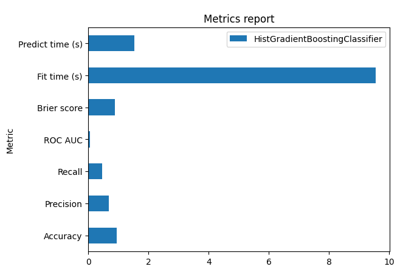
EstimatorReport: Get insights from any scikit-learn estimator

train_test_split: get diagnostics when splitting your data
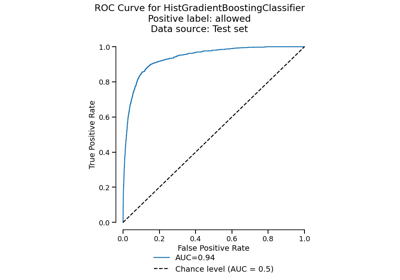
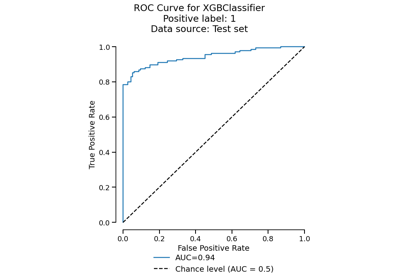
Using skore with scikit-learn compatible estimators
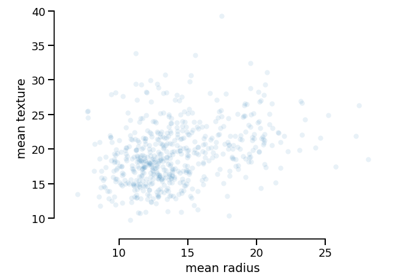

EstimatorReport: Inspecting your models with the feature importance